The Legend of Zelda: The Minish Cap
Overview
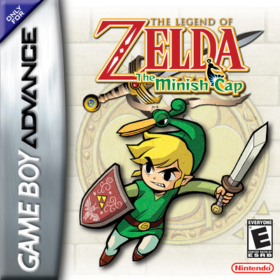
Link's only outing on the Game Boy Advance (other than The Legend of Zelda: A Link to the Past and Four Swords), The Legend of Zelda: The Minish Cap is a prequel to Four Swords with the origins of the Four Sword and antagonist Vaati.
Review
I have mixed feelings about this game, as it had the opportunity to go above and beyond the Game Boy origins of The Legend of Zelda: Oracle of Seasons and The Legend of Zelda: Oracle of Ages yet, feels weaker than both of them. All of these games share the same developer, Capcom/Flagship.
In addition to having some of the look and feel of the Oracle Series, it also blends some of the aesthetics (including 32-bit demake versions of recognizable characters) of The Wind Waker and having closer to a Link to the Past look and feel than the Oracle series did. When I say "weak" I don't mean "bad", I enjoyed more than I did Spirit Tracks and even then I doubt Spirit Tracks is the worst mainline Zelda game. (Even if you left out The Legend of Zelda: Echoes of Wisdom and The Legend of Zelda: Tri Force Heroes).
I played The Minish Cap back in the mid-2000s on a real GBA and later replayed it (started on emulator, finished on flash cart), and the whole intro sequence reminded me a bit of a compressed version of Chrono Trigger: sleepy-head hero heads to big festival celebrating some event...meets girl...something happens to girl...sent on quest...to make a long story short, Link's (then) trademark green hat comes in the form of Ezlo, a hat-shaped goose-like thing who Link saves from monsters and Ezlo pays back the favor by attaching to his head like a parasite. Luckily, Ezlo has the advantage of bringing Link to the Minish people, which are tiny little elf-like creatures who have the power to reforge a sacred sword, and of course Link gets the marching orders of four mystical elements (Water, Earth, Wind, and Fire, though not necessarily in that order), which are of course the four dungeons you need to reach...though there are actually six as one of those dungeons just yanks the Wind Element out of your hand for another item.
That's it, there's only five dungeons before the last one. These five dungeons, of course, mean only five extra Heart Containers, so like The Legend of Zelda: Majora's Mask Pieces of Heart are scattered absolutely everywhere, and the dungeons themselves aren't even that memorable. The items include some oddballs that don't have a lot of overworld use. In the first dungeon, you get the Gust Jar, an item that acts as a shop vac, the second dungeon grants you the Cane of Pacci, which allows you to flip things over, and another is literally just a lantern. The last dungeon has the Roc's Cape, making a reappearance from Oracle of Seasons but it's not fun to use like in that game, leaping across 3-tile pits and all. Meanwhile, the other, more familiar items take a backseat. It absolutely feels like they had to cut stuff, what with between the second and third dungeon getting TWO items (Pegasus Boots and the Bow) just to progress, and the Boomerang is something that is not only optional but also mostly useless.
That's not the only problem, there's other quirks, too—there's a whole thing about searching out each and every NPC (unusually, they all have names) and fusing "kinstones" with them (better keep a list), and the Compass no longer has the four-tone noise when there's a key or item hidden somewhere. There's also an arrow upgrade that you can permanently miss out on if you're not paying attention, too. One of the Heart Pieces is tied to the Figurine Quest, which not only is cumbersome to find shells to trade into the machine (and the whole process is very slow, expect to dedicate 45 minutes at the VERY minimum), but the game straight up lies to you about the probability of getting a new one.
In the end, it's a mixed bag. It's not like the two DS Zelda games that are riddled with problems (including the touch-based controls and lack of an overworld) as the The Minish Cap keeps a lot of things that made Link's Awakening and the Oracle series good...plus Ezlo has his moments, too, even if he acts like a surrogate Navi sometimes.
Finally, it gives Link a last name, his grandfather is named Master Smith, so that would make him Link Smith. At least this Link.
Player Notes
I finished this around early May 2026 for the first time...possibly ever. I got pretty far when it was new circa 2005 and I attempted a new run around 2023, but this is the first time I think I actually completed it. I previously rated this as "SOLID" (roughly 3/5) and I think that's a good rating.
Recommended Guide
I was lucky enough to use the Official Player's Guide for this game, which has maps and reference guides for the Kinstones. I haven't looked into alternatives for those that don't have a print copy.