
Title: |
|
Genre: |
|
|
Developer: |
|
|
Publisher: |
|
Release Date: |
|
On Wikipedia: |
|
Systems: |
|
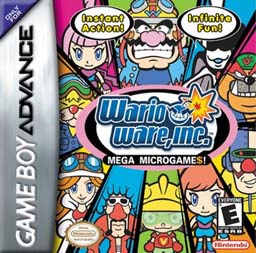
Wario Land 4 was a great game and in 2003 Nintendo R&D1 released a bit of a semi-sequel to it, WarioWare, Inc.: Mega Microgame$! (or sometimes the dollar sign isn't emphasized, and just called "WarioWare, Inc.: Mega Microgames!"...or its other regional titles, in Japan it's Made in Wario and in PAL regions it's WarioWare, Inc.: Minigame Mania. This game would irreversibly change Wario as a character and while it ultimately meant the death of Wario games like Wario Land 4 it at least provided a character arc, with the portly not-plumber using his wealth to go his own way, and introducing his cast of own characters.
The concept is a bunch of 5-second minigames that all have themes and their mini story arcs with characters, and it's surprisingly fun as many of these are creative and work together as a whole. In addition to reusing the weird sound effects and some other assets from Wario Land 4 (in general sharing its look and feel), much of it was also based on the "coffee break" minigames of the 64DD title Mario Artist: Polygon Studio, with some games directly copied from it. Not that it mattered—the game was never released in the West and was fairly obscure even by Japanese Nintendo standards.
It's definitely a weird game and I'm glad it got localized; the thumbnail is from the minigame "Nighttime Allergies" (though is definitely one of the more "out there" concepts). The follow-ups to this game ultimately rounded down the corners and rough edges that made this game what it was. As you progress, you can unlock other, more comprehensive games like a port of Dr. Mario (here called "Dr. Wario" with Wario playing the role of the good doctor), the Fly Swatter game from Mario Paint (the speed is adjusted slightly to make sense with D-pad, as the yellow-like wasps are a massive pain, though like every Game Boy Advance port, it doesn't sound quite right, even when you take into account the slightly remixed music), and Sheriff, perhaps the first video game Nintendo ever made (arcade, back in 1979) and something the company rarely talks about (though paid homage to in the Super Smash Bros. games), is playable as well. Sheriff wasn't a big success in the United States—it was launched in America as Bandido under Exidy, a long-defunct arcade manufacturer which made only a handful of titles, including controversial titles like Death Race and Chiller before fading into obscurity. There's a few 2-player minigames controlled with L and R (sharing the system), including one based after a novelty remote-controlled vacuum cleaner Nintendo made in 1979.
Sadly, where WarioWare, Inc.: Mega Microgame$! starts to fall apart is when you unlock all the minigames, with high scores required in them to unlock the final minigame, Pyoro 2. Trying to get high scores in all of the microgames...that is an awful experience. In WarioWare: Twisted!, there were a few games that required getting a high score of 20 if they were considered "easy" but in the first game, these things regularly go up to 20, if not 30. Unlike WarioWare: Twisted! you still get a point even if it's a miss, but it's much harder. There are three games that are functionally the same with just slight graphical changes (exact same style, even), "Zero to Hero", "Bam-Fu", and "Shingle Smasher".
In the near future I'll cover WarioWare: Twisted! which, along with the original, serves as the high-water mark for the series...but the series went downhill afterwards. This is mostly attributed to its developer, Nintendo R&D1, a group within Nintendo that was responsible for the Wario Land series (and before that, Super Mario Land, the division was mostly focused on the Game Boy and Virtual Boy, but not exclusively, as it also developed all the Metroid titles), merged with Nintendo R&D2 in 2004, and in 2015 the resulting merged studio, Nintendo SPD, merged out of existence itself. With the development of WarioWare moved fully over to Intelligent Systems by the late 2000s that's how we got WarioWare Gold, which I did NOT enjoy.
Box art from Wikipedia.
FINAL RATING: