Final Fantasy IV
Overview
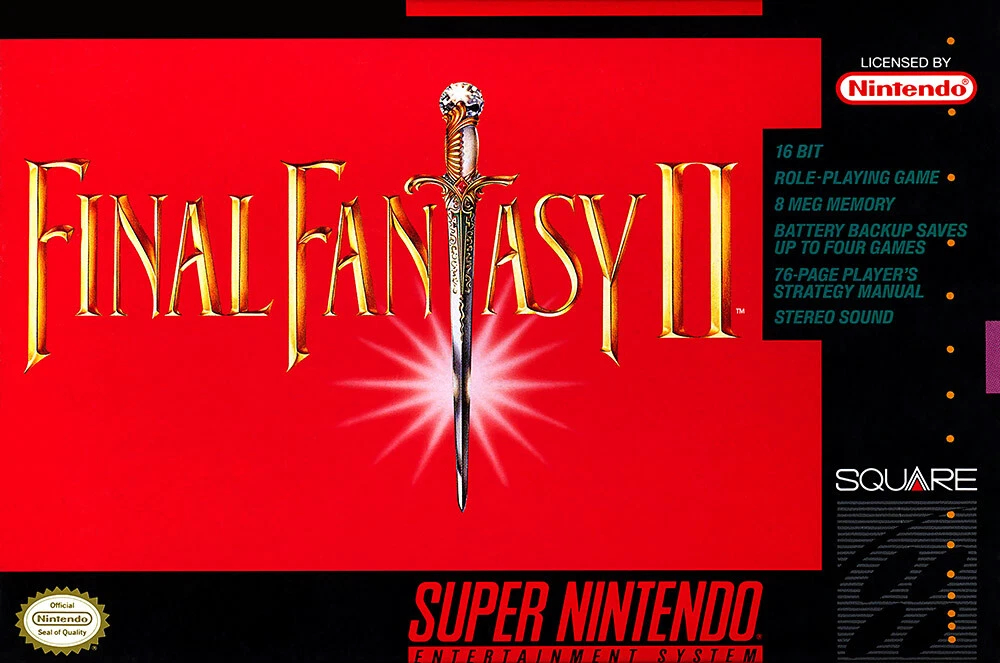
Released in North America as Final Fantasy II, this SNES JRPG suffers from some outdated mechanics and a poor translation; however it's still an essential piece of the Super NES library.
Review
I beat Final Fantasy VI (Final Fantasy III as was released in the West before Final Fantasy VII reset the numbering system) over a decade ago, but not Final Fantasy IV, released as Final Fantasy II when it first hit American store shelves back in November 1991, I had never really touched. I mean, I know I played it through some very early game years back, but that doesn't really count.
This review is written with around 80% of the game completed, as the last 20% is extremely difficult and my progress has slowed to a crawl.
It's a JRPG so I know what to expect (as far as SNES JRPGs go, I have beaten Chrono Trigger, Final Fantasy VI, EarthBound, and Super Mario RPG), but one thing that I noticed is that your party is never consistent, and I'm not sure if that's a good thing or not. I'm sure that story-wise everyone will be re-united at some point, but so far, your first companion, Kain, is swapped out for Rydia, then Tellah joins and is swapped out for Edward, then Rosa joins, then Yang joins, and you briefly have a full party of five people at one time (more than any SNES RPG) before Rosa leaves again, followed by everyone else in short order. The next town is the one you attacked at the beginning of the game, Mysidia, which the citizens are understandably pissed about Cecil, but take issue at him being a "Dark Knight", specifically, as if that's some sort of racist epithet, and that's where Cecil becomes a Paladin after "Mt. Ordeal" (where the source of Rule 165 comes in), though it isn't really built up all that much... Cecil feels guilty about the bad things the Order of the Red Wings does without question, and then when he accidentally genocides a small town he's quick to defend the survivor and fight his former employers/subordinates to the death early on.
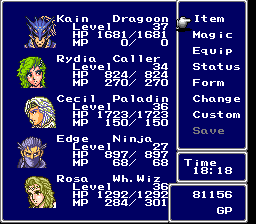
It seems five characters is the default, but you never swap out characters like in other SNES RPGs (Chrono Trigger, Final Fantasy VI, Super Mario RPG), the game does that for you, and soon you get five characters in your party again: Cecil, two wiz kids, or, wizard kids, Palom and Porom, and returning stars Tellah and Yang...you usually have five people in your party at all times short for a few segments as party members come and go, though Cecil is always there. It's not until around 85% of the way through when you finally complete the team you'll beat the final boss with. I don't want to spoil much more: most of the graphics are punched-up versions of what Final Fantasy III (on the Famicom) had to offer but with an actual story, actual characters, and better balanced mechanics.
I've heard some people say that Final Fantasy IV is better than Final Fantasy VI. I think there's some argument to be made, there's better pacing and your characters are actually useful (I don't think I ever used Relm and Setzer beyond what the story required), but in terms of presentation and story, VI wins (even with whatever you think of Woolsey's translation, it's miles ahead of the broken English in IV)...and if you wanted something like VI but with better pacing and more useful characters, there's Chrono Trigger. On the grand scheme of things it doesn't stack up to other Super NES Squaresoft RPGs and even Nintendo's own EarthBound (even accounting for the fact that I've soured on it over the years).
More recently I don't know. You don't keep the XP you earn if you die, and points of fully recovering your party become sparse. The translation isn't good with most of them being just copy-and-pasted from Japanese with some punched-up parts from Woolsey, and I might've hurt myself more by briefly using a "restoration" patch that helps with translation and censored elements while making the game much harder. Final Fantasy II as it was known in the West was based on Final Fantasy IV Easy Type, a modified version of the game released in Japan a few months after the original, though rather it being a version for babies and scrubs, it seems to have actually balanced the game better and adds some objectively new features like new graphics for the final boss's third phase and additional dialogue.
If I actually beat the game I might go back and update this review a bit but as it stands I think I have a pretty good feel for it.
Player Notes
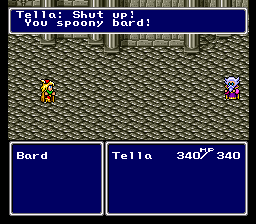
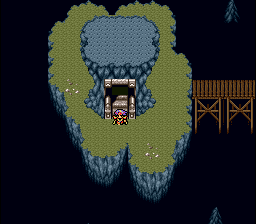
My description is based on what I previously wrote in 2022. While parts of this were written in the years following, this page finally was written in June 2026. The one with the famous "spoony bard" line is sourced from FantasyAnime, the second one is my own, and the third is from The Cutting Room Floor.
Port & Rerelease Notes
The main infobox is based on the release of Final Fantasy IV Easy Type (the publisher in Japan was Square, as Square Soft was strictly their North American publishing division). There are actually numerous ports of Final Fantasy IV that have been released over the years, which you can read about here. The original version of Final Fantasy IV was released in July 19, 1991 in Japan a few months before Easy Type, and Square/Square Enix has released multiple ports for systems following, first as part of Final Fantasy Chronicles for PlayStation in March 1997 (though wasn't released until 2001 for its U.S. release) which bundled it with Chrono Trigger, then a Japanese-only release for the Japanese-only WonderSwan Color, then on Game Boy Advance in December 2005 as Final Fantasy IV Advance (one of the late era GBA games and probably I'd be putting on that my flash cart if I hadn't already been invested in my SNES file), a mobile phone port in Japan (can't get this legitimately anymore), a straight port of the SNES version on the Wii as part of the Virtual Console (also can't get this legitimately anymore), a PSP port called Final Fantasy IV: The Complete Collection in 2011 (which bundles it with 2008's Final Fantasy IV: The After Years, and Final Fantasy IV Pixel Remaster for Steam and iOS/Android, which was then ported to PS4 and Nintendo Switch.
Screenshots