Final Fantasy VI
Overview
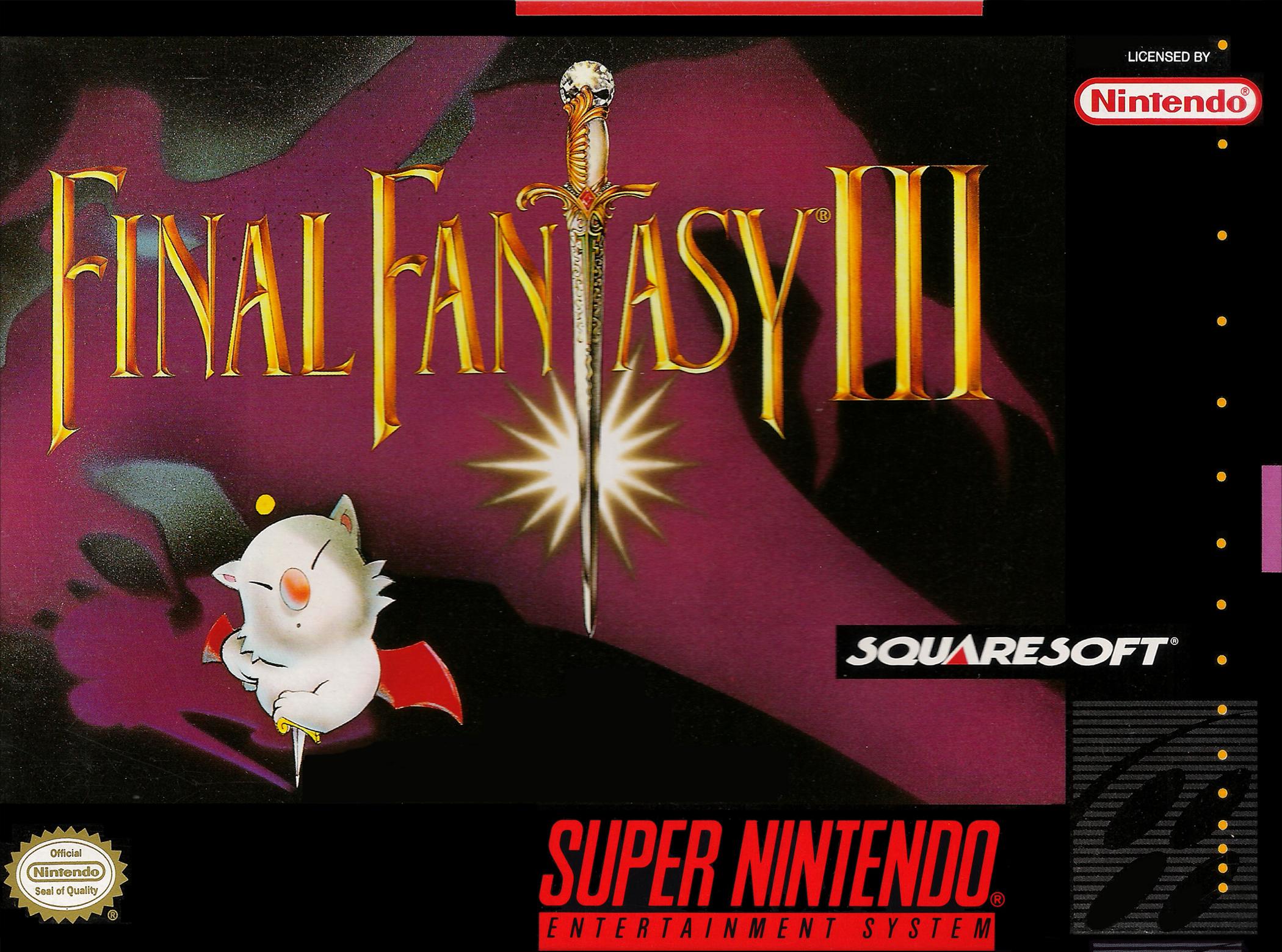
Final Fantasy VI (or Final Fantasy III as it was known when it was first released in the United States) is one of the SNES greats, if not THE greatest Super NES game, even if there's some minor weaknesses. The below review attempts to preserve as much as the old review (originally written in 2013 and revisions since) while attempting to modernize the format.
Review
It is no secret that the Super NES has one of the single greatest collection of games on a single system that was only in the market for less than a decade, and their RPGs—before RPGs (JRPGs, as we know them today) were hijacked by angsty androgynes, were some of the greatest the world had ever known. While there were more, things like the Lufia series, Final Fantasy II (Final Fantasy IV), and Secret of Mana, there were three that I did like and gave an honest spin back in the heady years of 2004-2005: Chrono Trigger, Final Fantasy VI, and EarthBound, and while I played a bit of Final Fantasy VI in November 2004 (the music was the best of the three, though Chrono Trigger was a strong candidate as well) it was only almost a decade later when I actually tried to progress further beyond what I had and I ended up beating it in March 2014 (a little more than a year on and off).
Unlike most of the earlier Final Fantasy games, Final Fantasy VI ditches the straight sword-n-sorcery/high fantasy setting for a more steampunk setting with an evil empire trying to revive the long-banished world of magic to rule it. There's some threat of world-destroying in there, and of course, like all games your goal is to prevent that from happening. In most RPGs you do. In EarthBound, which I finally beat legitimately in 2010, your goal was to prevent that from happening to your world, and in Chrono Trigger, you try to alter history from happening. Both succeed, of course, but in Final Fantasy VI, it doesn't. I knew that Kefka would alter the world, murdering Gestahl in the process (no loss, he's a bad guy), but it still hit me pretty hard and I bet I'll still be shocked when playing FFVII and see Sephiroth eviscerate Aerith with a sword. Of course, I wasn't quite as aware of FFVI spoilers, because partially I was surprised Nintendo even let them get away with that (more on that later).
From start to about 70% of the game (that other 30% involves sidequests and leveling up), it's an amazing journey, even though I missed a few plot elements I had to look up later (such as who Relm's father was) and about half-way through there is an attempted kidnapping mid-way through the game, and the accused kidnapper ends up joining your party (and forgiven for the rather felonious thing he intended to do). Eventually, I gathered all of my party members, ran through Kefka's Tower with great difficulty, and faced off the mad jester-like crazy-man himself, defeating him.
The defeat of Kefka particularly surprised me. Not because I was crazy overpowered--my party was at Lv50 or so, and I still had some problems with the bosses before Kefka, but it felt like it went too short (all things considered). Not that I would want to go on too long--the longer the battle goes on, Kefka would've countered with some nasty moves (like Ultima against YOU), but I was kind of half expecting to see Kefka morph into something 10 times as big and powerful, which at that point, he'd start pulling out the big guns and you know you're really in for a long and difficult battle. I know that's what Sephiroth does in FFVII but it's in Nintendo games too, with things like Chrono Trigger, The Legend of Zelda: Ocarina of Time, Super Mario RPG...and when I got to Kefka, I only battled once (maybe twice). I can't tell you how many times I died at Ganondorf's hands in Ocarina of Time, but it was a lot. Then again, I didn't search out the dozens and dozens of Heart Pieces that there are in the game, but that's okay, because if you're not good, your Heart Containers and potions will only delay the inevitable.
But the battle with Kefka only highlights one of the common problems with RPGs: the gameplay-story disconnect. Kefka is depicted as a god-like entity that could easily destroy entire cities (and he does), toss your party around like rag dolls in cut scenes (and he does), but you could take him out easily with the right moves. In any semi-realistic set-up, Kefka could slam down his hand and wipe out everybody. Game over. Credits roll.
While I admit there was a lot of level-grinding, there's a lot to talk about Final Fantasy VI that's worth talking about. When I first wrote part of this review, I wrote out some theories and other notes (the end of Espers being a bit more uplifting, with their souls being freed, or possibly returning to their home), but I lost the document unfortunately (it wasn't all that long). There's also the soundtrack, which is top-notch and I highly recommend finding it (don't pay more than $20). The way they push the Super Nintendo's soundchip for the heart-breaking opera scene is amazing, and that's not only the most emotional part of the game. An earlier part of the game comes when Kefka, in a moment of unforgivable villainy, poisons the water supply of a kingdom, and Cyan finds that he's the only survivor, the king, his wife, and son all fallen victim to poisoning. Soon after that, he joins others on a fight on the "Ghost Train", and after that mini-dungeon is complete, the train horn blows one last time, and Cyan sees his dead wife and son leaving on the train to parts unknown. That was the part that was really got those tearducts working right there. Clearly someone at TVTropes understands too.
In fact, there's a lot of very dark parts of Final Fantasy VI that I'm genuinely surprised they got away with an era of heavy censorship. While the game got some alcohol references mostly expunged (the common practice of changing "Pub" or "Bar" into "Cafe"), smoking, and some risqué graphics covered up, but they left a number of things intact, including references to suicide, and another scene that was censored in later releases (but not the original SNES version) where General Celes is imprisoned, and based on the sound effects is being beaten by soldiers while being chained to the wall. This is all made worse when you consider that according to official materials, despite rising to the ranks to a general (before being arrested for allying with the rebel forces), Celes is only supposed to be 18 (which is age of consent in most countries, admittedly), and par for the course of RPG heroes running pretty young (see next paragraph) but still, they've chained a teenager to the wall and beating her and Nintendo let that pass. It's not even one of the hidden things you can do that might've slipped past the radar (like what you can do to the hamster in Maniac Mansion), that's a vital story element!
You may, depending on your Internet history, recognize that as the "Logan's Run" rule, but keep in mind that list was designed with FFVI doing a lot of that stuff when these things were relatively fresh. Namely, I believe that #38 was first pioneered here, #52 is directly referencing FFVI (as with #56), #139 (I'm pretty sure), #181 (referenced by title), #123, #161, #120 (likely), and #118 (definitely). There are others I've missed, and a good chunk of the rest deal with Chrono Trigger, Final Fantasy VII, or Final Fantasy IV (and also FFVIII, which I've never played). On Chrono Trigger, there is some debate about which is better, Chrono Trigger or Final Fantasy VI.
I hope you guys will forgive me if I give Chrono Trigger second place, but only by a slight edge (reasons why are explained in the Chrono Trigger review, which I have yet to post as of this writing). Of course, if you're reading this, you either beat Final Fantasy VI or are playing it right now. You've also probably played (and if not, I highly recommend it) Super Mario RPG, a good "gateway" RPG starring everyone's favorite red-clad plumber and lovable characters who are still exclusive to that title (check out our review here). The biggest problems with Final Fantasy VI are problems inherent with JRPGs, namely level grinding and unbalanced characters (I think I spammed Sabin's Blitzes, and later the Ultimas I taught everyone). There's also other ways to cheese the game (the old, pre-2010 ports) like exploiting the "Psycho Cyan" bug.
The biggest disappointment (story-wise) was the wasting of Shadow's character. Keeping Shadow as a character and not letting him get killed off mid-game is a not-very-easily-telegraphed point but instead of allowing him to live out his life with a hopefully renewed sense of who he is, he prefers to stay and die at the end anyway, never even showing his face. It put a damper on the great closing sequence, and that part wasn't even done well. But overall, it's a fantastic game.
Player Notes
As I mentioned, I had played this very briefly in 2004 and then it kind of kicked around on the shelf for a while before trying it almost a decade later. When I played it, I used the SNES version, though I avoided using Relm's "Sketch" command because of its game-breaking capabilities. At the time when I played it, I didn't realize that Version 1.1 had fixed the bug and the bug didn't necessarily delete your save file if triggered. I didn't want to play dangerously, besides, Relm wasn't that good of a party member anyway.
When I was using a review system in 2023 I had rated it as "GOOD" (as opposed to "GREAT") which indicates that at the time I didn't think super-highly of it. Part of the issue was that I felt that there were some pacing issues, some parts were too rushed, an some parts were too slow.
Port & Rerelease Notes
There were a number of ports of Final Fantasy VI over the years, though all of them had disadvantages and advantages. It got a PlayStation port in 1999 with some bells and whistles but suffered from some poor optimization (and the disc-based system added loading times that weren't in the Super NES version).
It was released for the Game Boy Advance in 2007 as Final Fantasy VI Advance as one of the very last Game Boy Advance games (this is the version that future posts were based on) but there were issues with that one too, like the Game Boy Advance's soundchip (or rather, the lack thereof). There was an iOS port that received a Steam version, which was later discontinued (you can't get it anymore) for the "Pixel Remaster". While the Pixel Remaster does incorporate a lot of the features that were incorporated later, there's no easy way to make it look like the SNES version. I wouldn't be able to tell you which is the "best" version.
It should be noted that in the Game Boy Advance version and all versions since, Celes isn't struck while tied to the wall in regards to new rules on violence in Japanese media not for adult audiences. This has some rather interesting effects, notably in Metal Gear Solid Peace Walker, Snake gets tortured with electricity in Western versions but the Japanese version switches it to "laughing rods". Restoration patches (at least for the GBA version) exist.
Additional Content
Before they released the "Pixel Remaster" version, I had made some notes on it which are all obsolete now...and I wrote some spoiler-free tips as well. In this current version for the August 1, 2026 update, I'll throw in something else...the MP3 soundtrack (zipped).
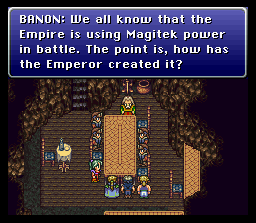
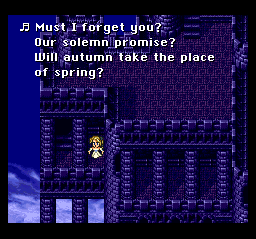
Screenshots


Recommended Guide
Nintendo did publish a Player's Guide for this title, but for me, it was StrategyWiki.