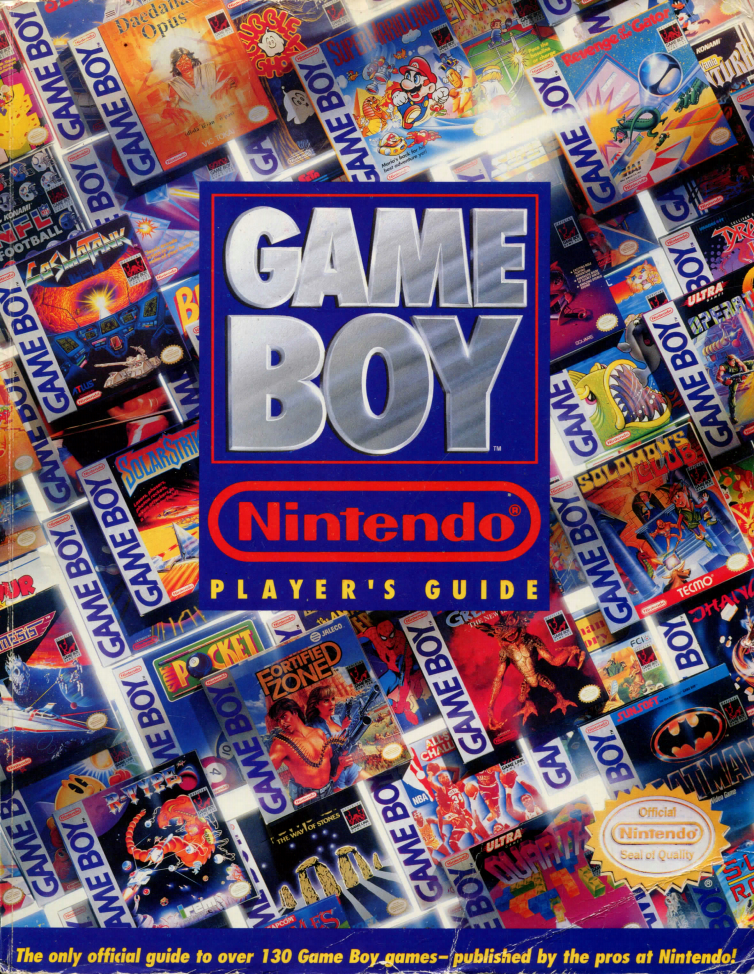
Nintendo Game Boy Player's Guide
Authors: n/a
Publisher: Nintendo of America, 1991
Pages: 176
ISBN-10: n/a
If you follow my ongoing reviews on Nintendo Power, in 1991 (first discussed on Volume 24) Nintendo rolled out the Player's Guide line, a series of books and guides on Nintendo games, taking the name from a book released shortly before the launch of Nintendo Power magazine.
The Game Boy book was the second in the line (the first was the NES Game Atlas) and very much like the original Official Nintendo Player's Guide it features maps and strategy for some of the bigger games and just paragraphs for others. The book is divided into five main sections for game genres, "Action", "Puzzle", "Adventure", "R.P.G.", and "Sports", then a directory and index. As a whole and much like Nintendo Power, the coverage is uneven, some get several pages, some get a paragraph, and the coverage itself is uneven. The Hunt for Red October (based after the 1990 movie with Sean Connery and Alec Baldwin) gets a full four pages with maps but Mega Man: Dr. Wily's Revenge (here again called "Mega Man in Dr. Wily's Revenge", as Nintendo Power called it) gets nothing but a paragraph.
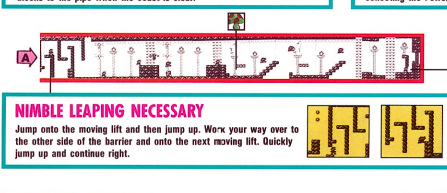
Going through the book, there's eight pages dedicated to Super Mario Land with maps. You could argue you don't need maps to Super Mario Land but they are incredibly small in the book, less than half an inch tall. They also aren't very good, either, I've attached a scan showing how the framing is correct for the maps but the screens are themselves skewed.
The other problem with the maps in this book and other early guides (as well as Nintendo Power during this time) is that the maps used aren't from data, they're just video capture screenshots, so the maps for Teenage Mutant Ninja Turtles: Fall of the Foot Clan (the second game featured) is full of extra Turtle sprites and they didn't bother to paint them out.
Batman also gets eight pages, Operation C gets six pages, Double Dragon gets six, Nemesis gets six, Castlevania: The Adventure gets six, Gremlins 2 (based on the sequel to the film, not a game sequel) gets six pages, and The Hunt for Red October gets four pages. At this rate things are looking good, with even third party games based on feature films getting full maps. But by R-Type they don't print maps for Stage 5 and Stage 6, and resorting to the Nintendo Power-style "this stage is tough, just keep shooting"-style "strategy" that doesn't really help when you most need it. Revenge of the 'Gator (the apostrophe is here in this guide, but never used when the magazine covered it), a pinball title, gets two pages.
Moving on to the Puzzle section, it starts with of course, Tetris. It and other early puzzle Game Boy hit Dr. Mario get four pages each. The guide recommends turning up the volume when you clear 20 vitamins and viruses at once (a 4x chain) as the "Game Boy will play a special (and familiar) tune you won't want to miss"! (For those wondering, it's this track). Kwirk gets two pages, as does Solomon's Club and Quarth.
Headlining the "Adventure" section is Gargoyle's Quest, which gets a full eight pages. Cosmo Tank gets six, Fortified Zone gets four, and DuckTales (here called "Disney's Duck Tales") gets six.
Headlining the "R.P.G." section, The Final Fantasy Legend gets eight pages with several tables and charts but its uneven, cutting out some sections and neglecting the last part of the game entirely. The Sword of Hope is eight pages but only makes it to the "final boss" which it spoils is not the actual final boss. There's six pages for Ultima: Runes of Virtue, the Game Boy-exclusive Ultima title, but there's no charts for it.
Finally, the Sports section includes Golf (four pages), F-1 Race (two pages), Days of Thunder (two pages), and Super R.C. Pro-Am (three pages). Days of Thunder, based after the eponymous film, has a very detailed look at the Daytona course but only has tiny blurbs on the other courses.
The "Game Boy Directory" is reminiscent of some of the "Now Playing" sections in Nintendo Power at the time, with box art, a few screenshots, and a paragraph, with the "index" mentioned previously the Game Pak Index, a listing of every Game Boy game at the time, players supported, the save format (battery, password, or neither), the Power Meter Rating (from Nintendo Power), the game category, and where it's found in the book.
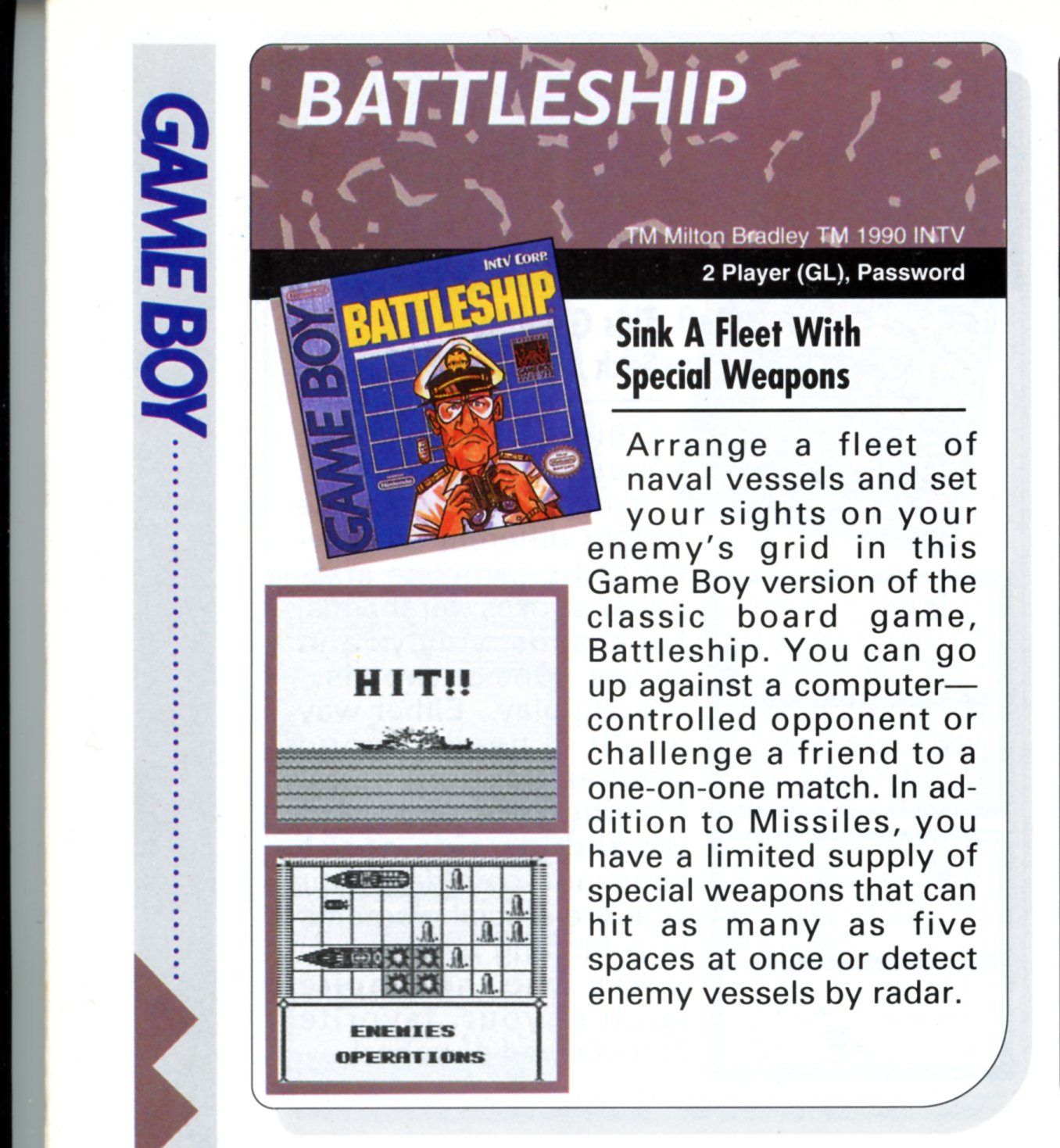
It should be noted that it covers Battleship with the original INTV Corporation box. This version, covered in Volume 21 was never released and wasn't released until 1992 by Mindscape (see Volume 44) and Mindscape used a different box. I think I prefer INTV's version (based on the original Japanese title, Kaisen Game: Navy Blue) over what Mindscape used. (The link to the Battleship profile is also shows what one of the sections for an average game looked like).
While the Super NES Player's Guide was released later that year and tended to follow the same design, I do think there's something to be said for the multi-game books. (Obviously some better balancing is needed). It's a good overall look at the system (at least as it stood at the time), but sadly it's one of the few that did (the Super NES book was another example, but it's one of a few that did). That being said I have a few words about their Super Game Boy guide, but I'll save that for when I actually write the review. (Not too positive.)
There's some decent scans (download the original PDF) on the Internet Archive, that's where the scans came from (not my own copy) except for the bit on Battleship.
Return to Main Page | Return to Books Index | Contact Me
© 2026 Carbon-izer.com