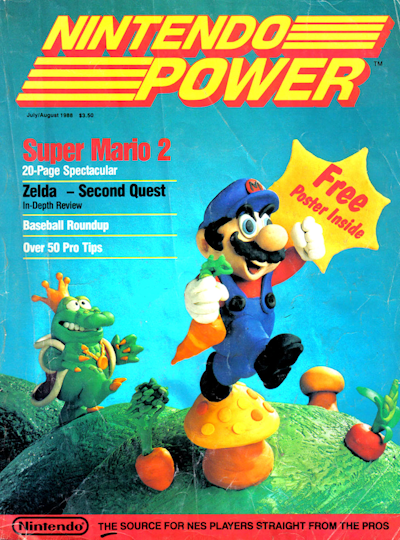
It all starts here in Volume 1 of Nintendo Power, the July/August 1988 issue. I suppose it's been covered partially by Fandom but that's no excuse for not having an article. Volume 1 has much, but not all, of the foundation that would be continued on for many years, even many of these features were stripped away in redesigns around 2000/2001 and 2005.
You can really tell how they really wanted to upgrade their publication chops. Nintendo Power was a magazine, while the Nintendo Fun Club News was just a newsletter. Some tips, latest games coming up, some pictures of an event, at least that was the case with the first issue. It reminds me a bit of K'NEXions. By the seventh issue Nintendo Fun Club News had a closer resemblance to Nintendo Power, but still not Nintendo Power.
The design of the magazine obviously took some inspiration from magazines like Famicom Tsūshin (Famitsu) and was co-produced by Tokuma Shoten, which published its own Famicom magazine, Family Computer Magazine (the first to do so). Nintendo Power featured a mixture of early-game strategy and late-game strategy for games, so it had the first six levels of Super Mario Bros. 2 (the cover feature, of course) but for the feature for The Legend of Zelda (which had been released almost a year prior at that point) it focused exclusively on the "second quest" and its remixed overworld and dungeons. There's a feature on three baseball games for the NES, Bases Loaded by Jaleco, Major League Baseball by LJN, and R.B.I. Baseball by Tengen. This last one is interesting because it was Tengen, which famously bypassed NES' lockout chip to make their own unlicensed games and the court battles that ensued. The ultimate result was that while some of Tengen's other games like Ms. Pac-Man were re-released by Namco as near-identical versions, R.B.I. Baseball basically became damnatio memoriae'd in the canonical American release list, even though the Japanese version (published by Namco) was still valid.
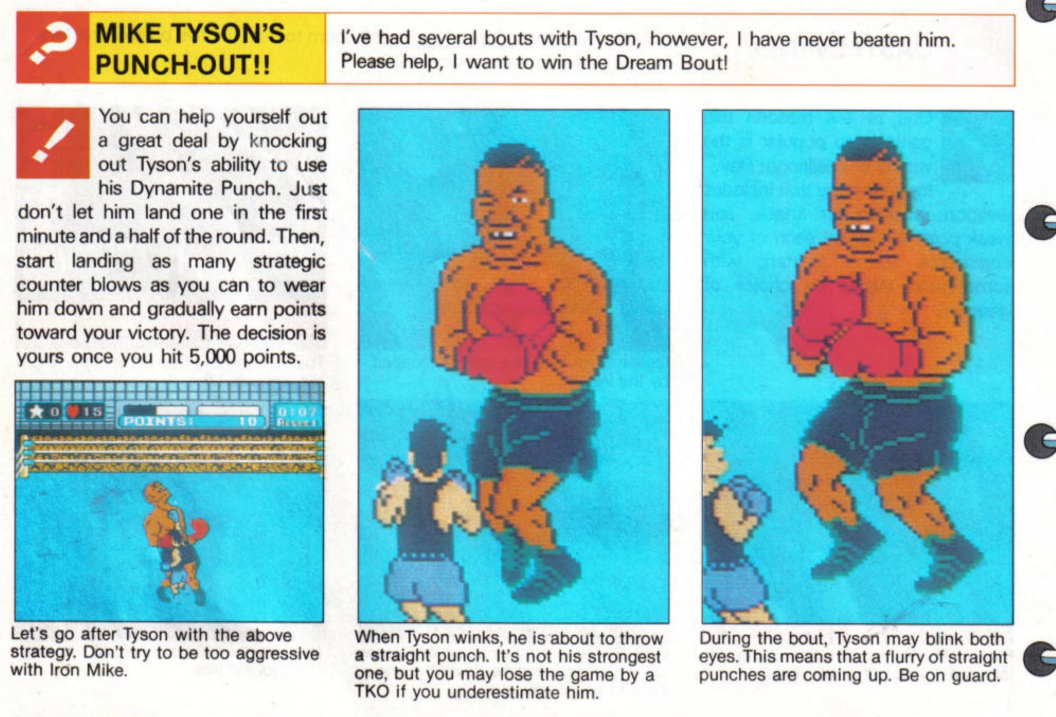
Don't be fooled. Knowing these telegraphs is not the key to winning, it's mostly practice.
Pretty much everything that would be there in some form or another even in early 2005 was there, including Counselor's Corner (which shared tips from the Nintendo help hotlines), with this issue having a (very shrunken in size) map of Metroid as well as some tips on beating the Dream Bout in Mike Tyson's Punch-Out!! (against Mike Tyson himself, of course). There's also some questions regarding Ghosts 'n Goblins, Ring King, Super Mario Bros. (regarding infinite 1-Ups), Kid Icarus (beating Hewdraw), Rygar, Castlevania, and Ikari Warriors. The Nintendo Game Counselors had a bit of mysticism about them, how they all seemed to be experts, but the reality was they had maps and guides that they had access to in binders, basically Nintendo Power and strategy guides in an easy form to go off of.
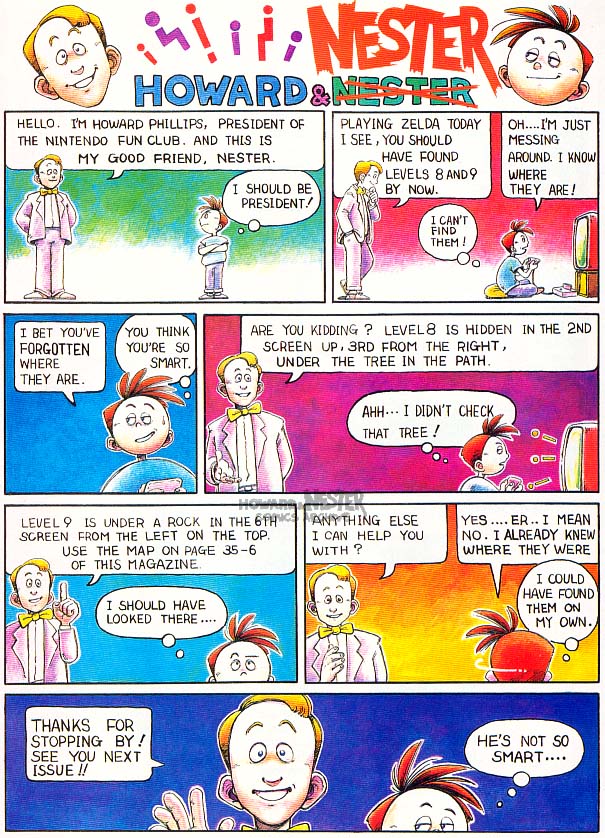
In the first two issues, Howard & Nester was one page. This would be expanded to two in Volume 3.
There's the first issue of Howard & Nester, a comic that ran in the early years featuring Howard Philips and Nester, the magazine's mascot. Things would change later, especially when Philips left Nintendo and Nester was soon retired shortly afterwards. When Howard left for Lucasfilm Games a few years later, slightly but decidedly more vulgar than usual. There's always some sort of internal joke or script with these sorts of things that gets leaked, like the "storyboard jam" script from Rugrats or "Rude Removal" from Dexter's Laboratory. The image above comes from Howard & Nester Comics Archive, a website that's been up since at least the early 2000s.
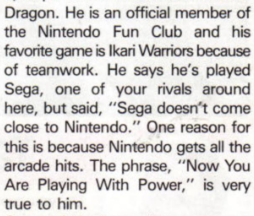
After Howard & Nester, comes Classified Information. This was the section, unlike Counselor's Corner, which helped with game advice, dealt with "top-secret program quirks and ultra techniques". In the premier, issue, these included a cheat on playing Ice Hockey with no goalies (for either team), starting with 30 extra lives in Contra, a code for a machine gun in Gunsmoke, how to pick any course in Rad Racer (and view the ending), how to get all the best items in the first area in Athena, passkey for "Another World Circuit" in Mike Tyson's Punch-Out!!, stage select and continuing in Arkanoid, being invincible in Ring King, finding the Ninja Girl and Princess in Ninja Kid, and a full page of tips for Zanac. After that, the strategy continues with a feature on Double Dragon, and "Now Playing", which would later be used as the name for the review section but here it's mini-strategy for NES games (Gauntlet, Contra, and two games by Gametek, Jeopardy! and Wheel of Fortune, based after the popular TV game shows).
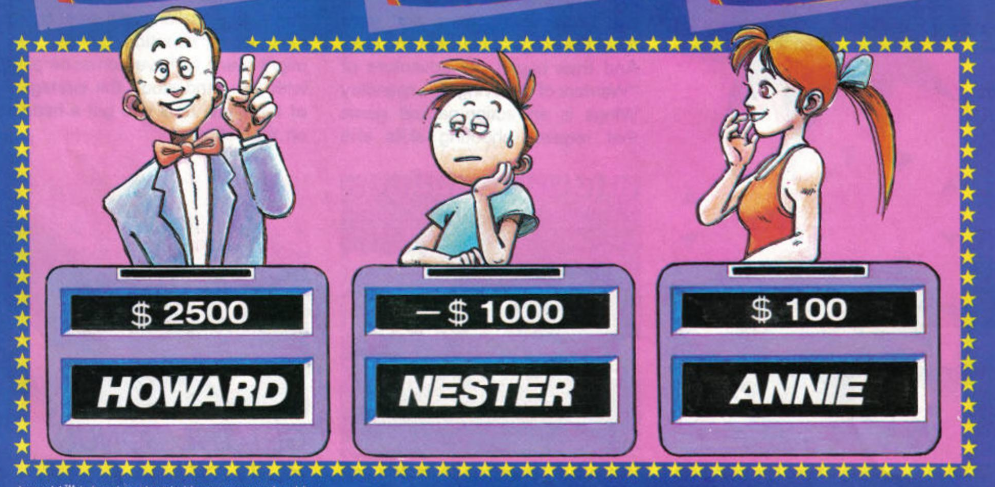
Do you want to see more of Annie? Too bad! This was the first and last time she showed up.
The other part of Now Playing was Video Shorts which featured "every single new-release video game now available or coming by the next issue for your NES". Obviously the games that were released before 1988 were never here and some games just got a listing with no real detail. I haven't cross-referenced to see if any games got shafted, but here the games were Legendary Wings, Iron Tank, Gunsmoke, Rambo, Dragon Power, Metal Gear, Bionic Commando, City Connection, Ikari Warriors II: Victory Road, Star Force, and Freedom Force.
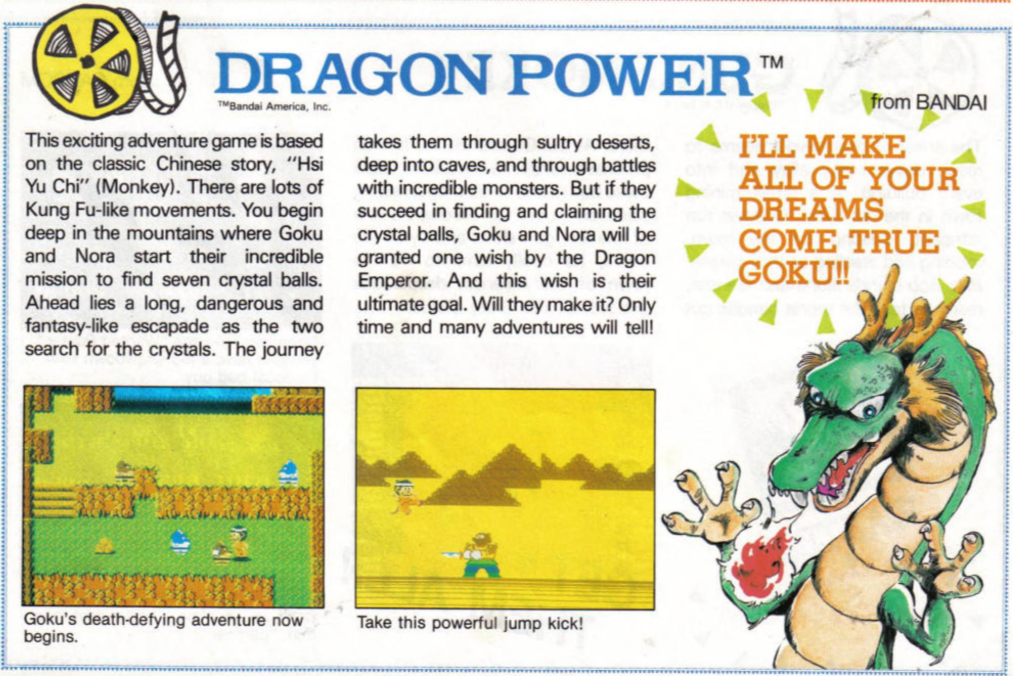
This "Goku" searches for...Dragon Balls, you might say.
Dragon Power is especially interesting as it sounds more like a certain manga/anime series than an adaptation of Journey to the West, because, well, it is. Most of the graphics were changed in the localization process and some of the names, but in Japan it's a lot more obvious. Pak Watch in its first form was just small blurbs of new games that were coming up: Indiana Jones and the Temple of Doom, Terra Cresta, Chester Field (ultimately not localized), 1943, Golgo 13: Top Secret Episode, Zelda II: The Adventure of Link ("it will definitely be available in stores by October"—it wasn't), Jackal, World Games, Robocop, Xenophobe, California Games, Life Force, Platoon, Lee Trevino's Fighting Golf, Castlevania II: Simon's Quest, Empire City: 1931 (also ultimately not localized), and Blaster Master. After this, it's the very first sweepstakes with what would be a running theme for a number of years. Grand prize (1), second prize (just the game), and 50 Nintendo Power shirts, only this time the grand prize is 10 games of your choice, second prize is just Super Mario Bros. 2 and instead of shirts, its longer-sleeved Nintendo Power jerseys! (Not sold in stores!)
NES Journal was basically the rest of the Nintendo Fun Club in a new format, the two books that Nintendo had for sale (the "Official Nintendo Player's Guide" and a guide for The Legend of Zelda, which can be seen here). There's also celebrity interviews who happen to like Nintendo games, with Kirk Cameron in Volume One (before his religious conversion and subsequent issues related to that). There was Mail Box, NES Achievers (later Power Players and eventually Arena) for high scores, Video Spotlight (a reader letter section specifically related to NES Achievers, this would be merged out of existence soon enough), and Top 30, which would later be the Power Charts. While this carried over to Power Charts, Top 30 had four lists, "Players' Picks" (reader chosen), "Pros' Picks" (guessing internal picks?), Dealers' Picks (sales), and a list that aggregated all three. The Official Nintendo Player's Guide was the surrogate Nintendo Power features for the games that didn't get listed. Unlike later Player's Guides, it wasn't meant to be a complete strategy guide, it was more of the Nintendo Power version, covering the early game and leaving out the last parts. So for Mike Tyson's Punch-Out!!, Bald Bull gets his own page (no mention of the camera flash trick, that was truly top secret), but for the World Circuit, for the truly difficult ones (I always stall out on Soda Popinski), it's just one page listing the others. There's maps for only half of Super Mario Bros. and not the castles with the repeating segments, and only a brief blurb for the 60+ games that didn't get strategies.
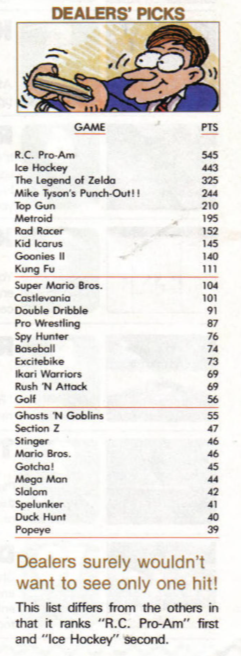
What kind of stuffed suit
steers away kids from "The Legend of
Zelda" to "Ice Hockey"? This is one reason why commissioned
salespeople went extinct.
The "Dealers' Picks" list is interesting however because it gives an insight into what people actually like and enjoy is different than what actually sells. Even years after sales all shifted to digital, this STILL holds true. The aggregated top five are all what you would expect in 1988 before the release of SMB2 or other heavy-hitting NES games...The Legend of Zelda, Mike Tyson's Punch-Out!!, Metroid ("Have you been able to reveal Samus' identity?"), Super Mario Bros., and Kid Icarus coming in at number five. (I can see why they later eventually went with top 10 instead of top 30...Renegade at #26? Ring King at #29? Who's heard of these?) Though if we were going with the top 10 the next five were R.C. Pro-Am, Ice Hockey, Rad Racer, Top Gun, and Double Dribble.
There was one thing in the Mail Box I wanted to discuss, it's this letter:
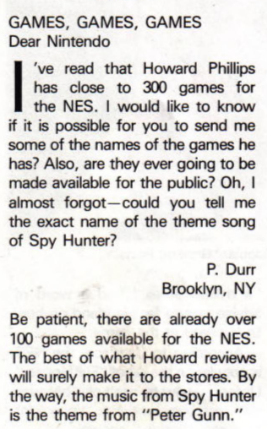
There were a lot of bad games for the NES, mostly Western licensed titles, but not much of the Famicom "kusoge" made it over. I'm sure they were under some sort of confidentiality agreement. Talking of the games that were stuck in Japan would probably make the worst game sound enticing, and the good games are still confidential. Also, there's this in the "Video Spotlight: Power Players" section. I'm sure that many people will be talking about their displeasure of Sega in the future.
Despite the growing pains it would later face, it's a promising start. (Let's go to the next issue!)
Return to Main Page | Return to Magazines Index | Contact Me
(c) 2026 Carbon-izer.com